Cantonment
Florida GOP Primary Concludes as Third-Place Finish by Fishback Highlights Economic Frustrations Among Younger Voters
TAMPA — Investment firm CEO James Fishback’s time in the Florida political spotlight ended Tuesday night when he finished a distant third with 10% of the vote in the race for the Republican nomination for governor. “He didn’t do great,…


Last updated:
Key points
- James Fishback secured approximately 10% of the vote in the Florida Republican gubernatorial primary, running on an anti-establishment populist platform focused on young voters.
- The campaign highlighted growing economic concerns among younger Floridians, including housing affordability, data center development, and tech surveillance regulations.
- With the primary concluded, the party turns its focus toward the general election and broad conservative policy priorities across the state.
TAMPA NewsWK — As Florida Republicans turn their attention to the upcoming general election, the conclusion of the statewide primary race for governor has brought into focus both the endurance of traditional conservative leadership and emerging populist undercurrents across the state. Investment executive James Fishback finished in third place in the Republican primary on Tuesday, capturing roughly 10 percent of the statewide vote after running an insurgent campaign focused on economic disruption, digital surveillance, and youth engagement.
While the nomination went decisively to frontrunner Byron Donalds, the primary demonstrated how specific economic and technological issues continue to resonate with a segment of the party’s younger demographic across Florida, including voters navigating high costs of living and shifts in the modern job market.
Why it matters here
For conservative voters throughout Escambia and Santa Rosa counties—from Pensacola and Cantonment to Milton and Gulf Breeze—statewide leadership sets the tone on critical pocketbook issues, property rights, and infrastructure governance. Northwest Florida is home to a rapidly growing population of young families, military veterans, and young professionals who face rising home prices, insurance pressures, and evolving labor dynamics.
The primary underscored policy debates that directly touch local communities across the Panhandle, including the regulation of automated surveillance tools like Flock license plate cameras used by local municipalities, the expansion of high-energy data centers, and the protection of domestic wages against foreign guest-worker visa programs such as H-1B visas. While mainstream conservative governance remains the dominant preference in Northwest Florida, the primary underscored that younger working-class voters are increasingly vocal about cost-of-living challenges and homeownership access.
A Campaign Focused on Youth and Disruption
Throughout his campaign, Fishback built a base primarily composed of voters aged 18 to 30, leaning heavily on direct digital messaging rather than conventional party infrastructure. His platform combined traditional social conservatism—including outspoken support for Christian principles and total bans on abortion—with aggressive populist stances against corporate subsidies, foreign labor visas, and emerging surveillance technologies.
Despite entering the race without previous political office or the backing of the party establishment, Fishback utilized social media outreach to reach younger voters who feel priced out of Florida’s housing market or disconnected from traditional party apparatuses.
In his concession remarks following the vote count, Fishback argued that his effort managed to activate voters who felt sidelined by traditional politics.
“Our opposition had over $100 million,” Fishback told supporters. “We had one percent of that. And yet, we secured 10 times as many votes as the dollars we raised.”
Legal Challenges and Campaign Controversies
The insurgent campaign was marked by several significant legal disputes and high-profile controversies throughout the election cycle. Prior to the primary, Fishback faced a legal challenge regarding Florida’s constitutional seven-year residency requirement brought forward by primary rival Jay Collins. Although evidence showed Fishback had maintained a homestead exemption and voted in Washington, D.C., in 2020, a Leon County judge declined to remove him from the ballot, ruling that the determination should ultimately rest with voters.
Additionally, a federal court previously ruled that Fishback owed more than $1.3 million to his former employer, Greenlight Capital, for breaching employment covenants involving confidential business information. His campaign also faced scrutiny over the selection of running mate Sean Lozano, a former law enforcement officer under administrative review in South Florida, as well as an unpaid scholarship dispute tied to a high school debate venture.
Tensions within the primary escalated sharply in the final weeks of the race when Fishback publicly claimed that Donalds was the subject of a federal criminal investigation. The Department of Justice promptly issued a statement refuting the assertion.
Addressing the matter, Donalds dismissed the unsubstantiated accusations as desperate political tactics.
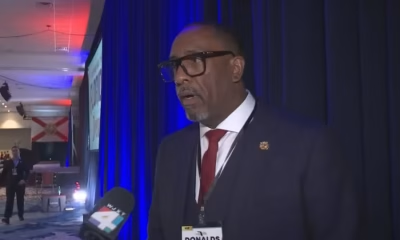
“Obviously, the accusations were some of the most ridiculous things I’ve ever heard in my life,” Donalds said, noting that such approaches emerge when campaigns fail to build broad, competitive coalitions on merit.
The Road to November
With primary disputes now settled, the Florida Republican Party enters the general election cycle focused on maintaining its strong governing majority and economic momentum statewide. For voters across Pensacola, Pace, Perdido Key, and surrounding communities, the focus shifts to ensuring that local and state policies foster sustainable economic growth, support law enforcement, defend constitutional freedoms, and keep Florida affordable for the next generation of homeowners and workers.
This article was produced with the assistance of AI and reviewed by our editorial team.